Human–Computer Interaction-Driven Analytical Framework for Determining Optimal Sustainable Agriculture Strategies
Keywords:
Human-computer interaction, Sustainable agriculture, Machine learning, Gaussian fuzzy sets, Multi-criteria decision-making, Renewable energy strategiesAbstract
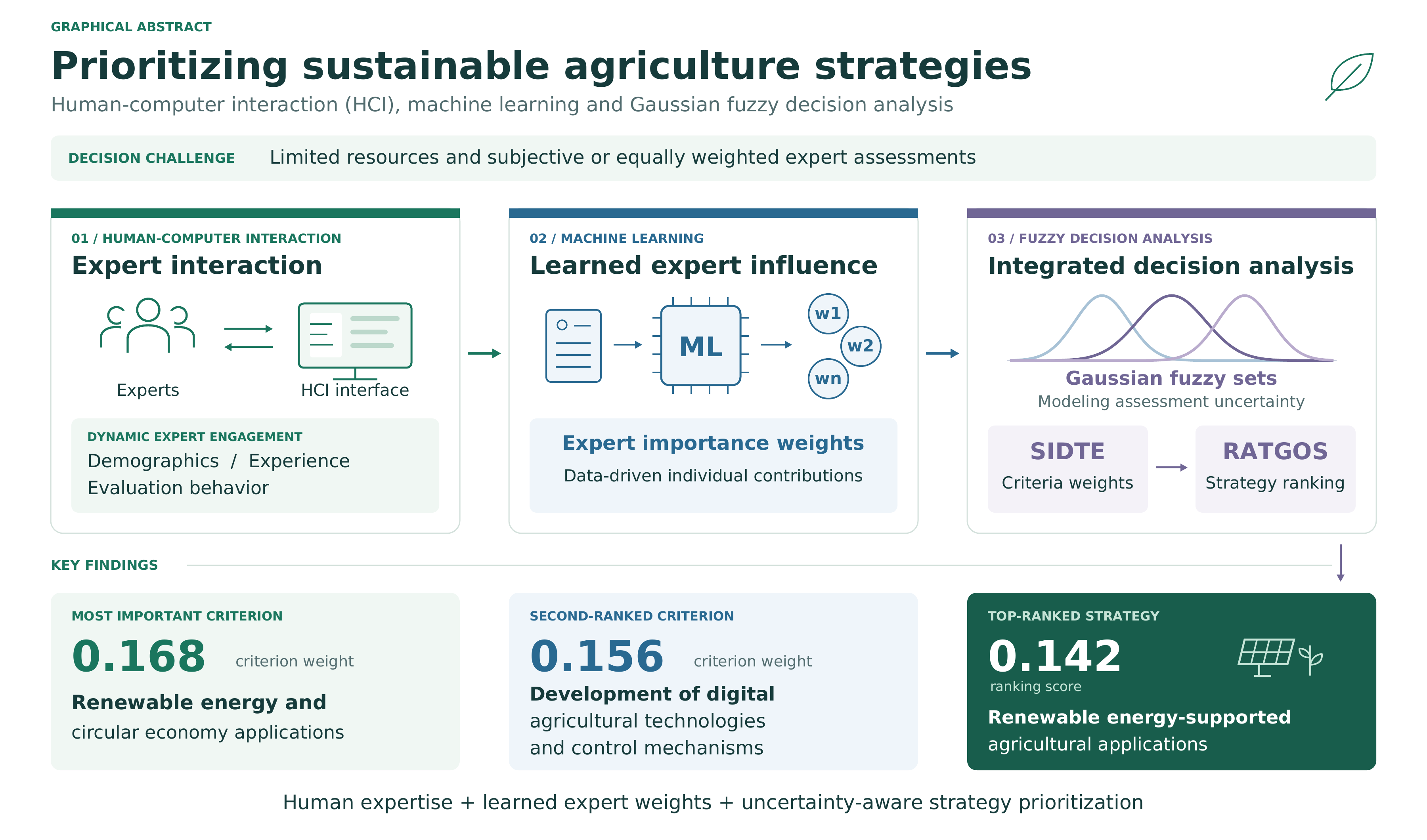
This study develops an innovative decision-making model for prioritizing sustainable agriculture strategies using a human-computer interaction (HCI)-based approach. A fundamental problem facing sustainable agriculture today is the inability to objectively determine which strategies will yield more effective results under limited resources. In the literature, most studies addressing this issue have subjective expert assessments, ignoring or assuming equal weight in the decision-making process. This methodological shortcoming reduces decision quality and limits implementation success. To address this shortcoming, the model developed establishes a dynamic interaction process with experts, in line with human-computer interaction principles, and determines the importance weights of experts using a machine learning algorithm. This approach objectively calculates each expert's contribution to the decision-making process by analyzing the experts' demographic characteristics, experience levels, and evaluation behaviors. In the analytical phase of the model, criteria weights are determined using the SIDTE method, alternative rankings are performed using the RATGOS technique, and Gaussian fuzzy sets are used to model uncertainties. Thanks to this integrated structure, the developed model offers a strong methodological contribution that fills the gap in the literature by integrating both human expertise and artificial intelligence-supported learning within the same framework. The findings indicate that the most important criterion is renewable energy and circular economy applications (.168), followed by the development of digital agricultural technologies and control mechanisms (.156). Furthermore, the most optimal sustainable agricultural strategy was determined to be renewable energy-supported agricultural applications (.142). These results demonstrate that human-computer interaction-supported machine learning-based decision models offer significant advantages in terms of both analytical accuracy and implementation efficiency in the development of sustainable agricultural policies.
Downloads
Published
How to Cite
Issue
Section
License
Copyright (c) 2026 Merve Acar, Serkan Eti, Ayşe Nur Çırak, Serhat Yüksel, Hasan Dinçer (Author)

This work is licensed under a Creative Commons Attribution 4.0 International License.