A Knowledge‑Driven Framework for Privacy Personalization in Smart Cities: Integrating Meta‑Synthesis, Fermatean Fuzzy SWARA, and Clustering Approach
Keywords:
Smart City, Clustering Techniques, Meta-synthesis Method, Knowledge Management, User Privacy, Fermatean Fuzzy SWARAAbstract
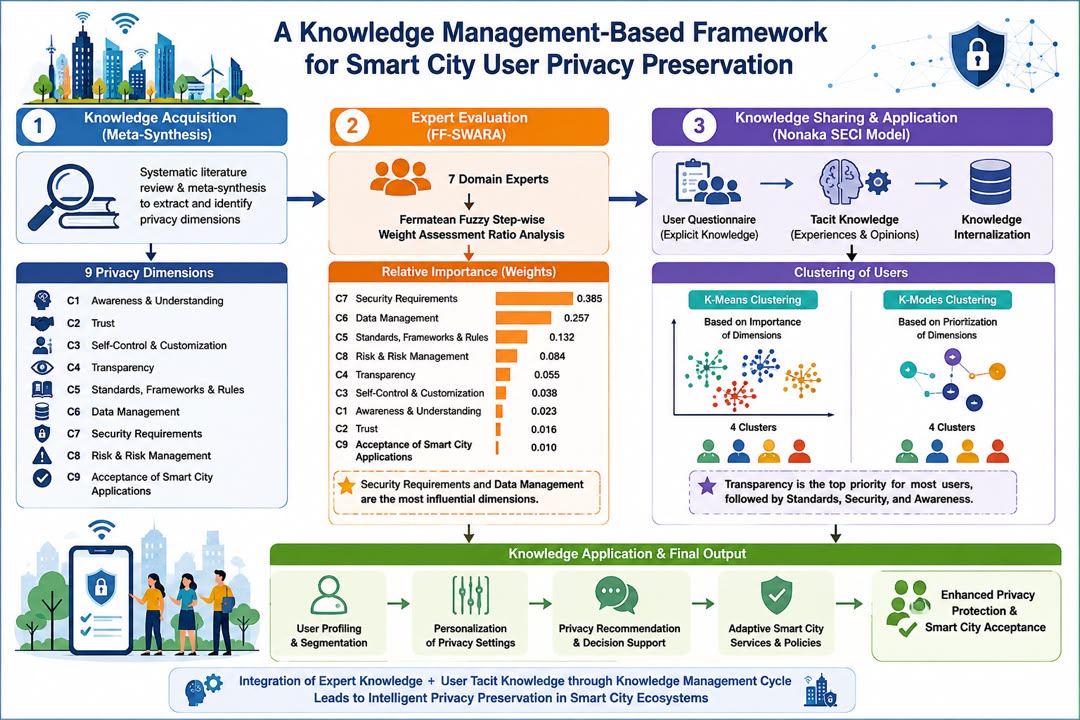
In recent years, smart cities have increasingly adopted digital technologies to improve public services, enhance citizens’ quality of life, and promote sustainable urban development. However, concerns regarding user privacy and security remain a major barrier to the widespread adoption of smart city services, often reducing users’ trust and willingness to engage with these technologies. This study proposes a knowledge management-based framework to support the personalization of user privacy in smart cities by applying the Wiig knowledge management cycle. First, a meta-synthesis approach is employed to identify the key dimensions, factors, and indicators affecting user privacy through a comprehensive review of the existing literature. The extracted knowledge is then refined and validated through semi-structured interviews with two domain experts. Subsequently, the relative importance of the identified dimensions is determined using the Fermatean Fuzzy Step-wise Weight Assessment Ratio Analysis (FF-SWARA) method based on the evaluations of seven experts. The results indicate that Security Requirements (C7) is the most influential dimension, followed by Data Management (C6), Reference Standards, Frameworks, and Rules (C5), Risk and Risk Management (C8), Transparency (C4), Self-Control and Customization (C3), Awareness and Understanding (C1), Trust (C2), and Acceptance of Smart City Applications (C9). The prioritized dimensions are then incorporated into a questionnaire administered to smart city users. Finally, machine learning clustering algorithms are applied to classify users according to their privacy preferences, enabling the development of personalized privacy recommendations tailored to the characteristics and expectations of each user group.
Downloads
Published
How to Cite
Issue
Section
License
Copyright (c) 2026 Mahmoud Zahedian Nezhad, Arezu Zamani, Tahereh Sepahi, Mohammad Mehraeen, Javad Nazarian-Jashnabadi (Author)

This work is licensed under a Creative Commons Attribution 4.0 International License.