A Simulation-Based Decision Support Framework for Resilient Public Pharmaceutical Chains: A Case Study
Keywords:
Public Healthcare Logistics; Pharmaceutical Distribution; Supply Chain Resilience; Simulation Modelling; Risk Analysis; Decision Support; Network DesignAbstract
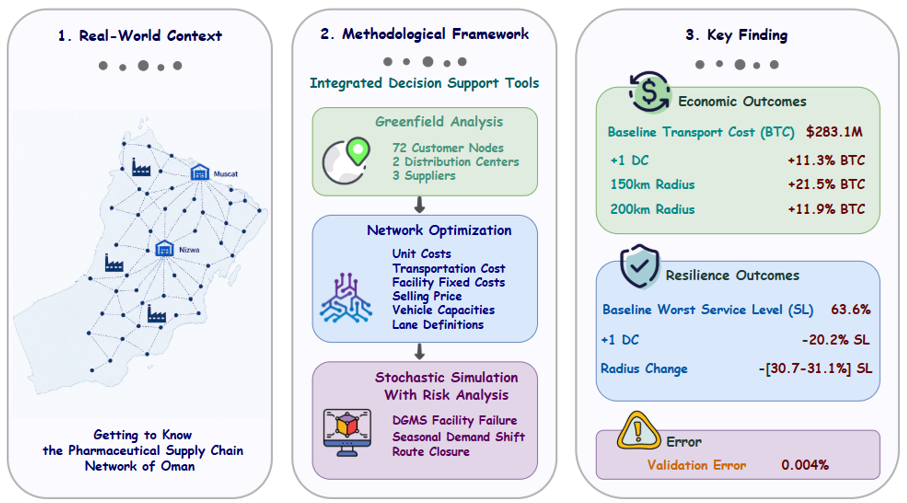
Public healthcare systems in emerging economies face growing challenges in maintaining resilient pharmaceutical supply chains due to geographic dispersion, seasonal demand variation, and operational disruptions. However, simulation-based decision-support approaches remain limited in government-operated healthcare logistics, particularly in the Middle East and North Africa. Therefore, this study develops and validates a simulation-based model of Oman’s public pharmaceutical distribution network to evaluate network performance and resilience under operational disruptions and structural changes. The model represents Oman’s 2024 distribution network, comprising two primary distribution centres and 72 public hospitals and health centres. Moreover, network analysis, optimization, and discrete-event simulation with risk analysis are integrated within a unified framework to support strategic network planning and decision-making. The model is validated by comparing simulated total supply cost with actual 2024 operating cost, resulting in an error of only 0.004%. Results show that the existing network provides moderate resilience, with service level declining to 63.6% under the most severe disruption scenario. Furthermore, adding a distribution centre increases transportation cost by 11.3% without improving resilience. Consequently, network expansion alone cannot ensure greater resilience, highlighting the need to consider the interrelationships among network structure, transportation cost, demand, and disruption risk when making strategic logistics decisions. Overall, the proposed framework supports evidence-based decision-making and planning for resilient public pharmaceutical logistics.
Downloads
Published
How to Cite
Issue
Section
License
Copyright (c) 2026 Dana Al Khusaibi, Dhuwa Al Amri, Samira Afsharfar, Sana Nabati, Reza Babazadeh, Mehdi A. Kamran (Author)

This work is licensed under a Creative Commons Attribution 4.0 International License.