Digital Twins as Enabler of Resilience in Pharmaceutical Supply Chains: Technological Applications, AI Implementation Gaps, and Regulatory Decision-Making
Keywords:
Digital Twins, Pharmaceutical Supply Chain, Supply Chain Resilience, Systematic Literature Review, Policy Analysis, Regulatory Governance, Digital TransformationAbstract
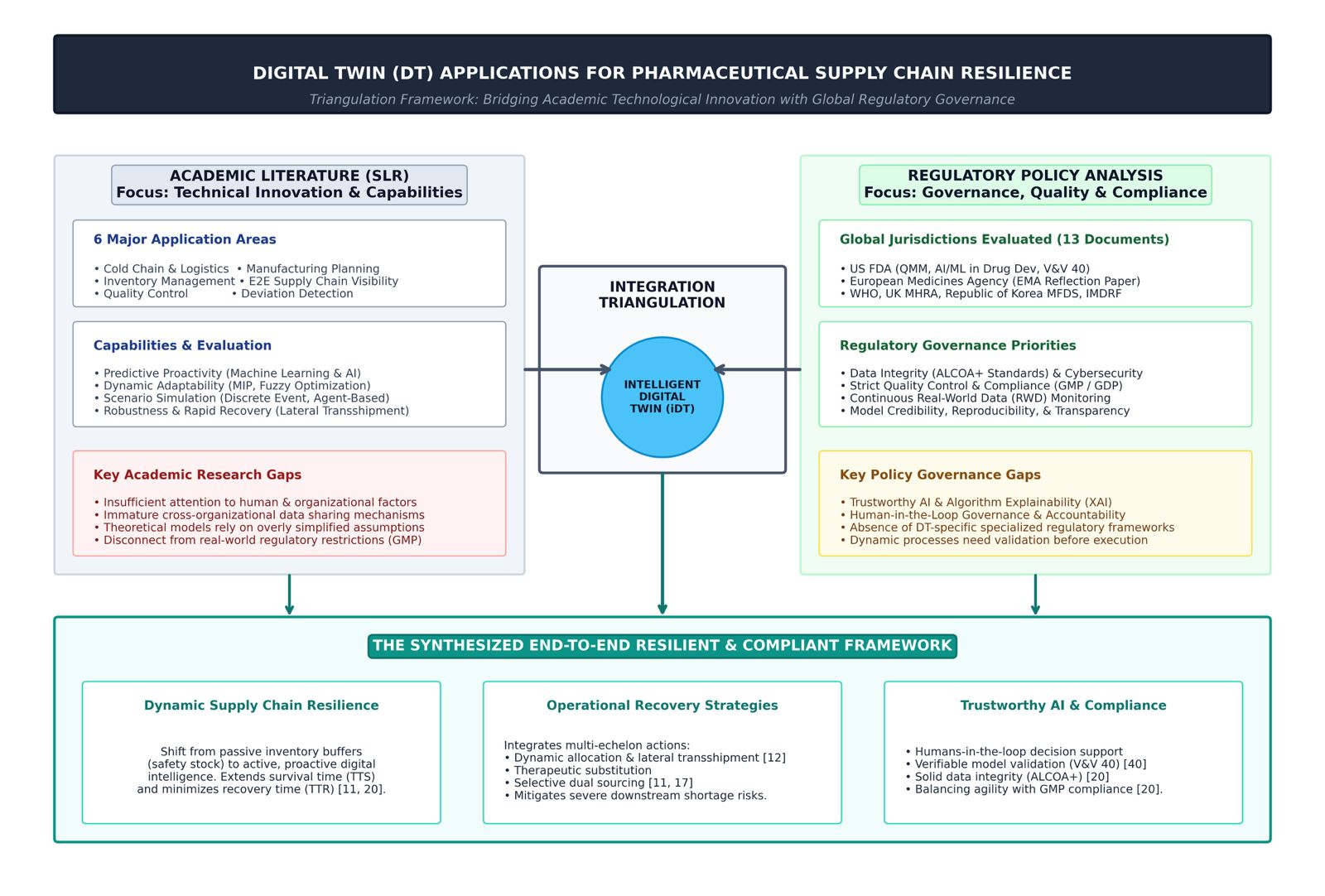
Recent disruptions, including the COVID-19 pandemic, geopolitical instability, and demand fluctuations, have exposed vulnerabilities in pharmaceutical supply chains and increased the need for resilient and adaptive systems. Digital Twins (DTs), integrating Internet of Things (IoT) technologies, artificial intelligence, real-time data, and simulation, offer opportunities to improve supply chain visibility, prediction, decision-making, and resilience. However, existing research on DT applications in pharmaceutical supply chains remains fragmented, with limited synthesis of regulatory and policy perspectives. This study conducts a Systematic Literature Review (SLR), following the PRISMA framework, to examine the applications, benefits, evaluation approaches, and research gaps associated with DTs in pharmaceutical supply chain resilience. Searches of Scopus, Web of Science, and Google Scholar identified 18 core studies for analysis. In addition, 13 international policy and regulatory documents were reviewed to examine the alignment between academic research and regulatory priorities. The findings identify six major application areas: manufacturing and production, inventory management, logistics and distribution, cold chain management, quality management, and end-to-end supply chain management. DTs contribute to enhanced visibility, forecasting, adaptability, resilience, and regulatory compliance. However, current research relies predominantly on scenario simulation, mathematical optimization, and conceptual frameworks, with limited empirical and real-world validation. Three major research gaps are identified: insufficient attention to organizational and human factors, immature cross-organizational data-sharing and collaboration mechanisms, and limited research on regulatory governance and implementation. Policy documents additionally emphasize model validation, data governance, cybersecurity, and compliance. Future research should therefore integrate technological innovation with organizational, data, and governance mechanisms to support resilient and practically deployable pharmaceutical supply chains.
Downloads
Published
How to Cite
Issue
Section
License
Copyright (c) 2026 Homa Molavi, Seyedeh Elaheh Molavi, Ju-Ting Yu (Author)

This work is licensed under a Creative Commons Attribution 4.0 International License.