Multimodal Wildfire Intelligence for Suppression-Zone Prioritization: Bayesian Fusion and Risk-Averse Stochastic Optimization
Keywords:
wildfire decision support; multimodal sensing; Bayesian data fusion; stochastic programming; conditional value-at-risk; resource staging; simulation validation.Abstract
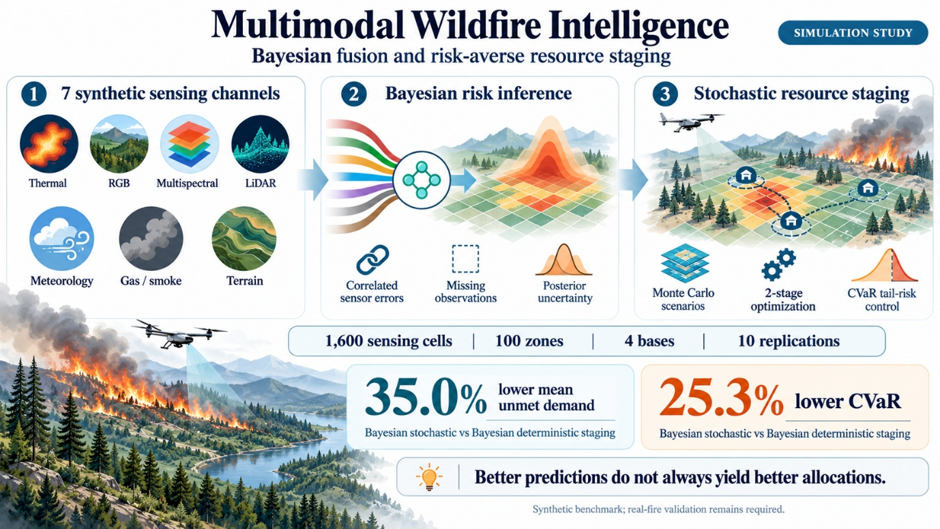
Wildfire decision support requires more than detecting fire: uncertain observations must inform feasible resource commitments before environmental conditions are fully known. This study develops a transparent interface between multimodal sensing, Bayesian risk estimation, and risk-averse suppression-resource staging. Thermal, red-green-blue (RGB), multispectral, light detection and ranging (LiDAR), meteorological, gas/smoke, and terrain channels are represented by correlated synthetic risk proxies on a 100 km² landscape containing 1,600 cells. Each of 10 independent replications generates 9,600 cell-time records; final-time predictive evaluation uses 16,000 records overall. A Gaussian Bayesian model accounts for heterogeneous measurement precision and missing channels. Posterior zone-level moments feed Monte Carlo demand scenarios with shared environmental disruptions. A 2-stage linear program stages divisible service capacity at 4 bases and allocates it among 100 operational zones. Evaluation uses 20 planning scenarios and 50 independent test scenarios per replication. Full fusion reduces mean Brier score from 0.1585 for thermal-only estimation to 0.1565, while latent-state root-mean-square error decreases from 0.5806 to 0.4991. Compared with Bayesian deterministic staging, Bayesian stochastic staging reduces mean priority-weighted unmet demand by 35.0% and conditional value-at-risk by 25.3%. However, its additional operational advantage over thermal-only stochastic staging is negligible within simulation uncertainty. Nominal posterior interval coverage deteriorates to 72.1% when unmodeled sensor noise doubles. These findings distinguish predictive information value from operational decision value. The study also specifies an auditable integration protocol for real wildfire datasets, without claiming empirical validation, physical fire-spread simulation, autonomous deployment readiness, or universally superior performance from adding modalities.
Downloads
Published
How to Cite
Issue
Section
License
Copyright (c) 2026 Seyyed Alireza Hoseini, Leila Daneshvar, Fatemeh Zarghami, Mahyar Khoshantash, Zahra Mohemmi (Author)

This work is licensed under a Creative Commons Attribution 4.0 International License.