How Consistent Are University Sustainability Rankings? Concordance, Consensus, and Sources of Divergence across Three Global Systems
Keywords:
University sustainability rankings, ranking concordance, ranking divergence, higher education sustainability, sustainability assessmentAbstract
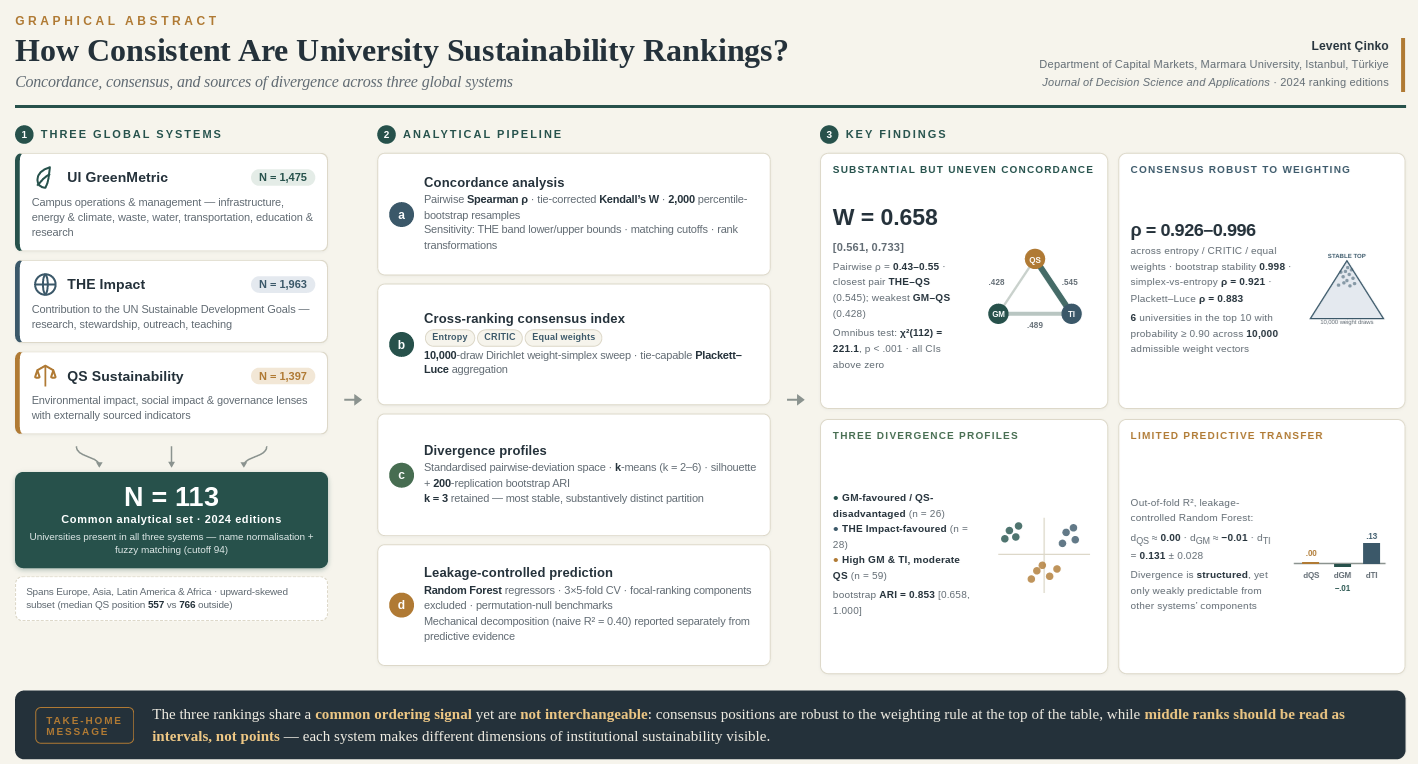
University sustainability rankings have become influential tools for comparing institutions whose environmental, social, governance, and public engagement activities are multidimensional and only partly observable. Their growing use creates an important methodological problem because different ranking systems may assign distinct meanings to sustainability, rely on different data infrastructures, and transform heterogeneous evidence into apparently comparable ordinal positions. This study investigates the extent to which the UI GreenMetric World University Rankings, the Times Higher Education Impact Rankings, and the QS Sustainability Rankings convey a common ordering signal, while also examining the sources and implications of their divergence. The analysis first harmonizes institutional identities and constructs a common comparison base. It then evaluates pairwise concordance and overall agreement, develops a cross-ranking consensus ordering under entropy, CRITIC, and equal weighting, assesses rank stability across the admissible weight space, identifies descriptive divergence profiles, and applies leakage-controlled predictive models to examine whether the components of one ranking explain divergence in another. The results indicate meaningful but incomplete agreement across the systems. The shared signal is strongest among institutions that perform consistently across several dimensions, whereas middle and lower positions are more sensitive to the weighting rule and the composition of the underlying indicators. The consensus analysis therefore offers a structured comparison rather than a claim that the rankings measure a single latent sustainability construct. The divergence profiles further show that institutions can reach similar overall positions through different combinations of environmental, social, governance, research, and engagement-related strengths. Predictive analyses provide limited evidence that the component scores of one systems explain out-of-sample divergence in another. The study concludes that sustainability rankings should be interpreted as complementary information systems rather than interchangeable measures, and that responsible comparison requires explicit attention to methodological design, uncertainty, and the distinct institutional dimensions represented by each ranking.
Downloads
Published
How to Cite
Issue
Section
License
Copyright (c) 2026 Levent Çinko (Author)

This work is licensed under a Creative Commons Attribution 4.0 International License.