System Availability Optimization: Integrating Quantity Discounts and Delivery Lead Time Considerations
DOI:
https://doi.org/10.59543/wrg7xp12Keywords:
System availability; Markov chain; Supplier selection; Quantity-based discount; Delivery lead time; Multi-state systemAbstract
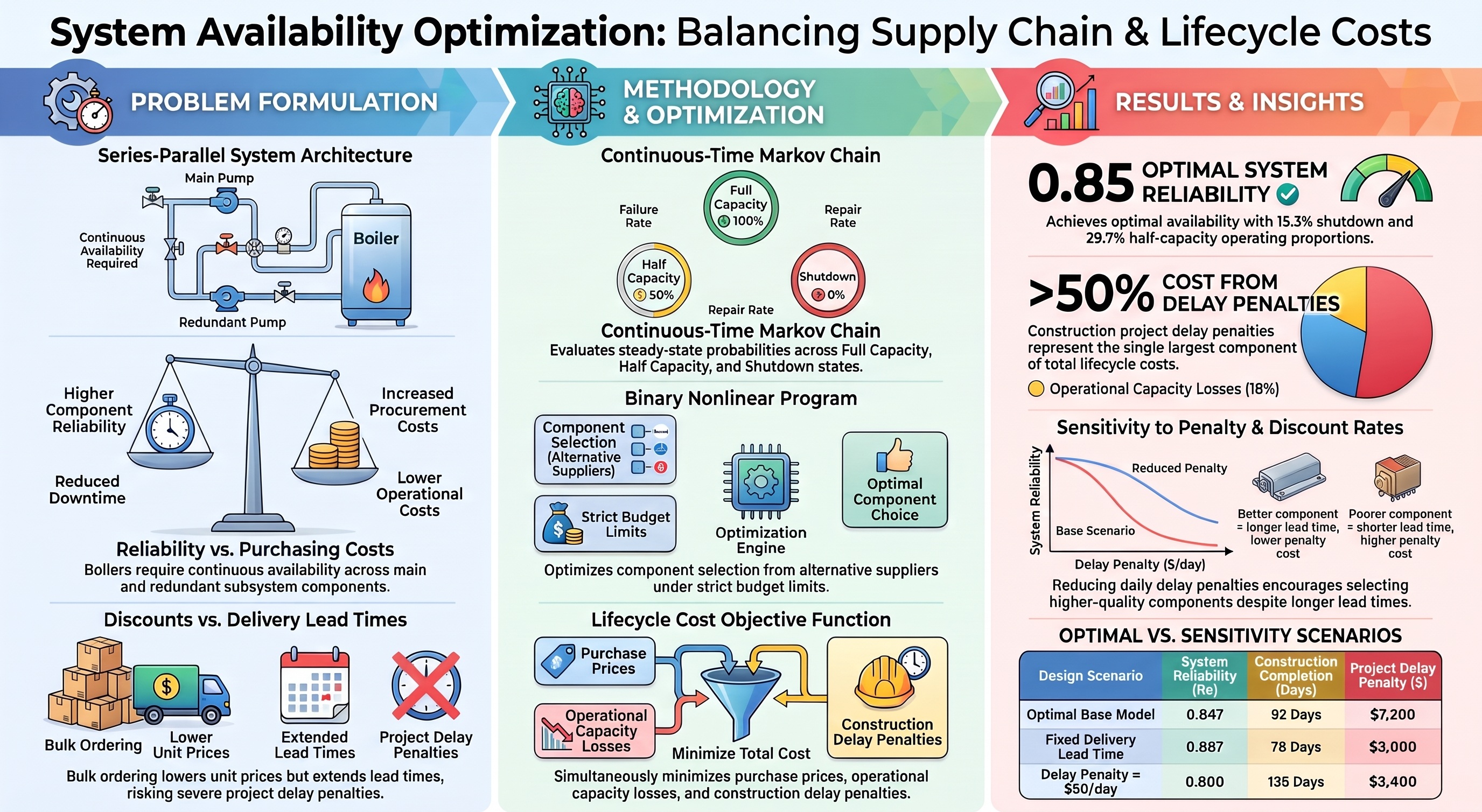
Designing an industrial system involves a trade-off between the quality of its components, their purchasing cost, and the time needed to deliver and assemble them. Higher-quality components increase system availability but cost more, and large orders reduce unit prices through quantity-based discounts but extend delivery lead times, which may delay system construction and incur penalties. This paper proposes a model that allocates the orders of the components of a series-parallel multi-state system to alternative suppliers, considering price, reliability, repair rate, quantity-based discount, and delivery lead time simultaneously. The system is described by a continuous-time Markov chain with full-capacity, half-capacity, and shutdown states, whose steady-state probabilities are embedded in a nonlinear binary mathematical program. The program minimizes the total cost of the construction phase, including component purchase and project delay penalties, and of the exploitation phase, including the cost of operating at half capacity and of shutdown, subject to a budget limit, precedence relations among assembly activities, and a minimum system reliability. A numerical example based on the feedwater system of heat recovery steam generator boilers in combined-cycle power plants illustrates the model. The optimal plan achieves a system reliability of about 0.85, and the delay penalty accounts for more than half of the total cost. Sensitivity analyses show that removing quantity-based discounts lowers the quality of the selected components and increases operating costs, that a fixed delivery lead time leads to the selection of high-reliability components, and that the daily delay penalty is the most influential parameter. The proposed approach helps decision makers balance construction objectives and long-term operational availability.
Downloads
Published
How to Cite
Issue
Section
License
Copyright (c) 2026 Zahra Sobhani, Mahmoud Shahrokhi, Robert Keyser (Author)

This work is licensed under a Creative Commons Attribution 4.0 International License.